
Quick answer: Yes, you can wear sandals to the office in India in 2026, provided they are closed-strap, structured, PU or leather-look sandals in black or brown, not flip-flops, sports slides, or beach wear. The distinction your HR manager actually cares about isn't "sandals vs shoes." It's "sloppy vs structured." This guide breaks down exactly where that line sits, and shows you the styles that sit safely on the right side of it.
If you've typed "office sandals for men" into Google before a Monday morning meeting, you already know the real question isn't philosophical. It's practical: will this get a second glance from your manager, or will it get you sent home from a client floor? Indian summers make closed shoes genuinely painful for eight-plus hours, yet almost no company handbook spells out sandals as "approved." That grey zone is where most men's footwear anxiety lives, and it's exactly what this article resolves.
The Old Rule vs. the 2026 Reality
Ten years ago, "office footwear" in India meant one thing: closed leather shoes, laced, polished, no exceptions. That rule made sense when offices were built around client-facing floors, formal hierarchies, and a dress code inherited from British administrative tradition. It didn't make much sense for the actual Indian climate, where humidity above 80% and temperatures past 35°C turn closed shoes into a daily discomfort tax.
What's changed by 2026 isn't the weather. It's the workplace. Hybrid schedules, IT and services-led hiring, startup culture, and a broader shift toward output-based evaluation (rather than appearance-based evaluation) have loosened dress codes across sectors that were once rigidly formal. Most mid-size and large Indian companies now operate on a "smart casual" or "business casual" standard rather than strict formal wear, and that shift has quietly opened the door to well-made sandals, especially for roles that aren't client-facing every single day.
The keyword here is "well-made." Dress codes relaxed; standards for what counts as presentable did not disappear. A structured, closed-strap sandal in a neutral colour reads as intentional. A worn-out flip-flop reads as an afterthought. HR and reporting managers rarely object to the former and almost always flag the latter.
What "Office Sandals" Actually Means (And What It Doesn't)
This is where most searches go wrong. "Sandals" is a broad category that includes everything from a bathroom slide to a hiking sandal to a formal strap sandal. Office-appropriate sandals for men are a specific, narrower subset. Here's the working definition:
- Closed or semi-closed strap structure: multiple straps across the foot, not a single flip-flop thong.
- Neutral, formal colour: black, dark brown, or tan. Bright colours, sport-mesh textures, and neon soles are out.
- Low-profile, structured sole: a flat or slightly built-up sole that mimics the silhouette of a formal shoe, not a thick sports sandal sole.
- Leather-look or PU upper: a matte or lightly textured finish that reads as polished, not a shiny rubber or plastic finish.
What doesn't qualify, no matter how comfortable it is: rubber flip-flops, sports sandals with visible Velcro and mesh, bathroom slides, or anything you'd wear to a beach or a gym. If you wouldn't wear it to a family function, don't wear it to a client meeting either. The overlap between "festival-ready ethnic sandal" and "office-ready sandal" is larger than most men expect, because both categories prize a clean strap line and a neutral upper.
Why This Question Even Exists: The Comfort-vs-Convention Conflict
Every man who has searched for office sandals is really asking a version of the same question: why should I suffer through eight hours of a closed shoe, sweat-soaked socks, and blistered heels, when a well-built sandal solves all three problems and costs less? It's a fair question, and the honest answer is: you shouldn't have to, in most modern Indian workplaces.
The hesitation usually comes from three sources, and each has a straightforward fix:
- "What if my manager says something?" - Preempt it. If your company has a written dress code, check it (most only prohibit "informal" or "beach" footwear, not sandals generally). If unwritten, look at what senior colleagues wear on a normal Tuesday, not a client-visit day.
- "What if it looks unprofessional?" - This comes down entirely to the sandal, not the category. A structured black office sandal with formal trousers looks more put-together than a scuffed, ill-fitting closed shoe.
- "What if my feet look bad?" - Basic grooming (trimmed nails, clean feet) plus a well-fitted sandal solves this in under two minutes a day.
Once the sandal itself meets the four criteria above, the hesitation usually resolves on its own. The problem was never really about sandals as a category. It was about the wrong sandals wearing the category's reputation.
When Sandals Are the Right Call, and When They're Not
Context still matters, and being deliberate about it is what separates a confident dresser from someone who just got lucky.
Sandals generally work well for internal-facing roles (engineering, back-office, support, and analytics), hybrid or work-from-home days with occasional office visits, startups and mid-size firms with a stated casual or smart-casual policy, and any role where you're not walking into a client's office or a board meeting that day.
Stick to closed shoes for: first client meetings, interviews, board presentations, government or PSU offices (which tend to run more formal by default), and any workplace where your reporting manager has explicitly asked for closed footwear. When in doubt on a specific day, closed shoes are the safer default. But for the other 80% of the working week, a well-chosen sandal is a legitimate, comfortable, professional option, not a compromise.
The Five Non-Negotiables of a Genuinely Office-Ready Sandal
If you're evaluating any sandal, from any brand, before wearing it to work, run it against this checklist:
1. Strap architecture that reads as structured. Two or three straps across the foot, ideally with a slight overlap or buckle detail, immediately look more considered than a single thong strap.
2. A cushioned PU footbed. Eight-plus hours on your feet demands real cushioning, not a flat, hard base. Polyurethane holds its shape through a full workday and doesn't compress into a rock-hard base within weeks, the way cheaper foam does.
3. An anti-skid sole. Office floors are often polished tile or marble. A grippy, textured outsole isn't a luxury; it's basic safety, especially the moment monsoon tracks water indoors.
4. Colour discipline. Black or dark brown covers 90% of Indian formal and business-casual dress codes. Tan works for lighter, more relaxed offices. Anything brighter should stay in your weekend rotation.
5. A finish that photographs well in daylight. Video calls and in-person meetings both expose scuffed, dull, or visibly synthetic-looking uppers. A matte, leather-textured PU finish avoids the "plastic slipper" look entirely.
This is precisely the brief Uniteds' Men's Sandals collection was built around, not as a marketing angle, but as a manufacturing standard applied to every pair before it ships.
Meet the Uniteds Office Wear Range
Uniteds is a direct-from-manufacturer footwear brand, built and shipped from our own facility in Kolkata. We don't resell someone else's stock; we design the mould, source the PU, bond the sole, and quality-check every pair ourselves. That's what lets us hold a genuinely low price without cutting the corners that make a sandal fall apart by month three.
Within the broader men's sandals collection, a handful of styles are built specifically around the office-ready checklist above:
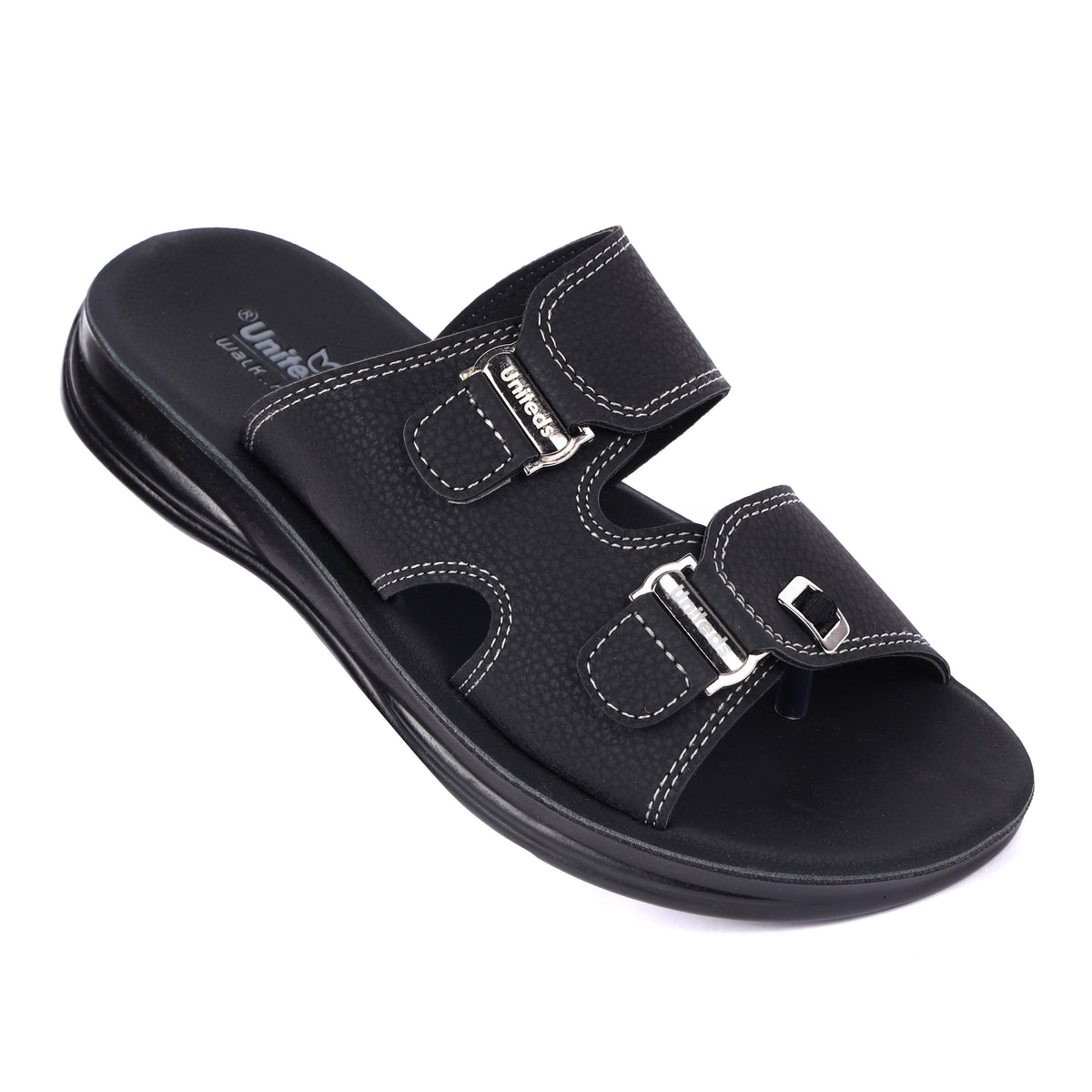
Men's PU Office Wear Sandals (₹399): Our most direct answer to "office sandals for men." A closed, structured strap layout in black and brown, a cushioned PU footbed, and an anti-skid sole built for polished office floors. This is the pair we'd point a first-time buyer to.
Men's Office Wear PU Sandals – Brown & Black (₹549): A step up in strap detailing for anyone who wants a slightly more premium silhouette without moving into leather-shoe pricing.
Men's Office & Daily Wear PU Sandals (₹399): Built to double up – office on weekdays, errands and travel on weekends, without looking out of place in either setting.
Men's Daily Wear & Office Sandals – Dark Brown & Black (₹379): A slightly more relaxed strap pattern for offices with a genuinely casual dress code, still dark, still structured, still appropriate.
Every one of these sits inside our full men's sandals collection, alongside daily wear, sports, and flip-flop styles, with sizes running true to Indian foot sizing from UK 5 to UK 10.
How to Style Office Sandals Without Overthinking It
The goal is coherence, not complexity. A few combinations that consistently work in Indian office settings:
- Formal trousers + black office sandals: the safest, most universally acceptable pairing for business-casual environments. Keep socks off or use no-show liners.
- Chinos + tan or brown office sandals: for smart-casual offices, startups, and creative teams.
- Half-sleeve formal shirt, tucked in + black sandals: reads as put-together for internal meetings and standard workdays.
- Kurta or ethnic wear + neutral strap sandals: for festival days or ethnic-day policies many Indian offices still run.
Avoid pairing sandals with shorts, joggers, or anything overtly athletic, even on the most relaxed Friday. The sandal can carry a business-casual look; it can't rescue a genuinely casual outfit into office territory.
Common Mistakes That Undo an Otherwise Good Choice
Most footwear complaints from managers aren't really about sandals as a category, they're about specific, avoidable errors:
- Wearing visibly worn-out pairs. A flattened footbed or frayed strap signals neglect, regardless of the original style.
- Mismatched formality. A sports sandal under formal trousers looks like a mistake, not a choice.
- Ignoring foot grooming. Open or semi-open footwear puts your feet on display; basic upkeep is part of the "professional" package.
- Skipping the anti-skid check. A slide on a wet office floor is a genuinely bad first impression, and an avoidable injury risk.
Each of these is a five-minute fix once you're aware of it, and none of them are reasons to avoid sandals altogether.
Caring for Office Sandals So They Last a Full Year
PU sandals are low-maintenance, but a small routine extends their working life significantly, especially for a pair worn five days a week:
- Wipe the footbed and straps with a damp cloth at the end of each day, particularly during monsoon.
- Use mild soap and a soft brush for stains; avoid harsh detergents that dry out PU over time.
- Air-dry away from direct sunlight, which stiffens PU and accelerates cracking.
- Rotate between two pairs if you're wearing sandals daily, giving the footbed time to decompress between wears.
- Store in a dry, dust-free spot, especially important during humid months.
Treated this way, a well-made pair from our office wear range routinely holds up for a full year of five-day workweeks.
Frequently Asked Questions
Q1. Are sandals allowed in Indian corporate offices in 2026?
Most business-casual and smart-casual Indian workplaces now permit closed-strap, structured sandals, especially for internal-facing roles. Formal or client-facing days, and traditionally formal sectors like government or PSU offices, still generally call for closed shoes. Always check your specific company's written policy, or observe what senior colleagues wear on an ordinary day.
Q2. What's the difference between office sandals and casual sandals?
Office sandals for men use a closed, multi-strap layout, a neutral colour (black, brown, tan), and a low-profile, structured sole. Casual sandals include flip-flops, single-strap thongs, and sports-style sandals with mesh or bright accents, none of which read as formal.
Q3. Can I wear sandals with formal trousers?
Yes. A structured black or dark brown sandal pairs naturally with formal trousers and is one of the most common business-casual combinations in Indian offices today. Keep the sandal clean, well-fitted, and free of visible wear.
Q4. What should I look for when buying office sandals for men?
Prioritise a cushioned PU footbed, an anti-skid sole, closed or semi-closed straps, and a neutral matte finish. These four features are the difference between a sandal that holds up for a full workday and one that doesn't survive a single humid afternoon.
Q5. Are Uniteds office sandals durable enough for daily office use?
Yes. Every pair in our men's office wear range is manufactured in-house with a cushioned PU footbed and anti-skid sole, tested for daily Indian office conditions, and backed by verified customer reviews on each product page.
The Bottom Line
You can wear sandals to the office in 2026, and in most Indian workplaces, nobody will look twice, as long as the pair itself earns that trust. Structured straps, a neutral colour, a cushioned footbed, and an anti-skid sole are the entire brief. Everything else, flip-flops, sports slides, worn-out pairs, is what actually damages a professional impression, not the category of "sandal" itself.
If you're ready to make the switch, our Men's Sandals collection carries the full office wear range starting at ₹399, direct from our Kolkata factory, with pan-India delivery and real customer reviews on every product page.